Showing posts with label Articles. Show all posts
Wednesday, January 17, 2018
Spotlight: Randall P. Dark
MediaTech Ventures Director, Paul O'Brien caught up with HD Pioneer, Randall Dark at a coffee shop in Austin, Texas. They talked about the longevity of Dark's storied career. Below is his interview found here.
-----
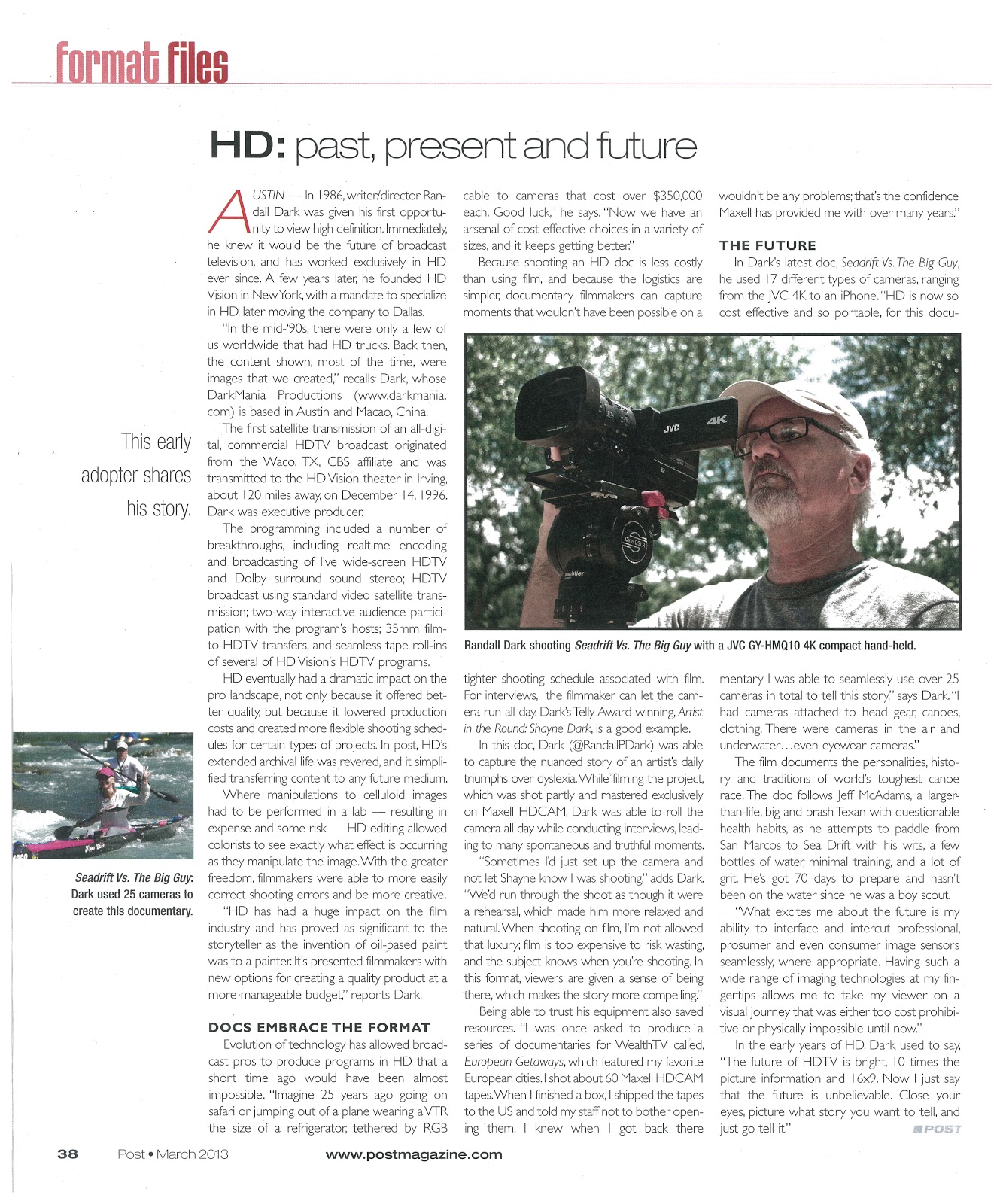
If you’re old enough to have used a cassette tape, I’d be surprised if that photo isn’t imprinted on the back of your brain as it was one of the iconic images of the 1980’s. That anonymous man in the chair, who he was and what we were experiencing in that poster – music, speakers, print, early MusicTech – in many way exemplify, by inspiring, what you might think of as a MediaTech professional.
I sat in a local coffee shop in Austin, TX, months ago, and shared passions and possibilities with a now clean(er) cut and gray Randall Dark.
In meeting for the first time, I had no idea that the poster from my youth, a poster that got me excited about music and audio, had Dark so early in my life as to influence my path toward media innovation. He’s an exciting personality, visionary, passionate, and just what you’d expect from a Canadian: a person you just enjoy spending time with.
WRITER, DIRECTOR AND PRODUCER
Today, Dark is a director, producer, writer, cinematographer, and media consultant who has not only embraced new camera technology, he is considered by the television industry to be one of the guiding thought leaders and adopters of the HD medium. Since seeing HD first in 1986, if you can believe, he has gone on to capture on the screen Julie Andrews, Bill Clinton, Willie Nelson, Harry Connick Jr., Leonard Nimoy, Lyle Lovett, Sting, and Stephen Hawking.
“Because high definition was so real and so vivid — the colours were perfect, you could see the tiniest detail — I believed that if you had a 65-inch TV in your home and you watched a documentary about starving children, it would touch your heart in a way that you would have to react,” says Dark. “I believed it was a technology that would have an impact on people and change their hearts. I honestly believed it would change humanity.”
Evidence of our vision that media cross pollinates throughout music, video, and other formats, Dark, found himself from Canada (he’s a native of Saskatchewan) to New York City, working out of the Ed Sullivan Theatre, where he worked with bands like Aerosmith and Crosby, Stills and Nash. He helped build one of the first multi-camera, high-definition production trucks and shot Victor-Victoria on Broadway with Julie Andrews. We all know the significance of the media in sports and Dark was behind the camera for Super Bowl XXX and NBA All-Star games as well as the first to broadcast in high definition a live sporting event to the National Press Club in Washington, D.C. as the American Public looked to Congress and the FCC to determine if high definition was a viable new TV standard for the United States.
In 2013, he found himself collaborating with Willie Nelson, Kris Kristofferson, Harry Connick Jr., Connie Britten and Lyle Lovett as one of the executive producers of Angels Sing and of watching Nelson and Connick Jr. create a new song, he noted, “I got to watch these two geniuses at work. My life is so amazing. I have never been star-struck working with celebrities because people are just people. I think what happens is so many big name stars get worshipped and people go ‘I’m a big fan’ and it gets tiring after a while. I think, because I am an expert in my field I can sit down and say, ‘Hey, I know nothing about what you do but do you want to know about high definition?'”
I could relate. This is the guy who sat the chair of a poster on my wall for years when I was growing up. Yeah, I’m that much of a media geek that I had a Maxell cassette tape poster on my wall. I was a little star-struck, here I was having coffee with an inspiration of mine that I’d not even realized until I met him. Dark, pointedly, wasn’t in that original chair; his influence is such that he recreated it with Maxell.
Dark is a media personality that we want to spotlight not just because of my personal connection with him. He is known for taking the experimental approach that we want to challenge everyone to embrace. He’s long been digital technologies and as we all wonder at HOW we can afford quality media production, whether we’re advertising, producing a film, or in need of a music video, he just does it. For his 2012 documentary Seadrift vs The Big Guy, he used an Apple iPhone and a 4K camera. Whatever it takes.
Truly, embracing all forms of media. If you’re as inspired to write as am I, you can appreciate that bubbling in the back of such a brain are stories to be told, and not always through video. Dark wrote a children’s play some 25 years ago, Tale of Sasquatch, and found it later published by the Playwrights Guild of Canada. Today, it’s an animated mobile app, available now [android | apple].
What brought us together to share chairs in a coffee shop was our alignment on so many ideas for the future of media and it’s therein that I’d like to encourage you to get to know Randall Dark. Thinking globally and in the sense of how networking and education will drive forward our media economy, he co-founded the Macao China International Digital Camera Festival and serves today as its artistic director. He, as do we, works with companies and non-profit organizations on how to use technology to grow their businesses.
To see articles written about Randall and the projects he has been involved in, check out his blog. Curious about listening to more of his story? Join him on Marsha Casper Cook’s podcast World Of Ink Network as they explore even writing books beyond producing movies.
Tuesday, April 25, 2017
2017 Studio50 Honorees Revealed
Randall P. Dark was chosen as FILMMAKER in the category of THE INDEPENDENTS. Here is his interview:
Randall Dark is a long-standing innovator in digital video, having founded HD Vision in New York City in 1992, becoming one of the first specialists in the technology behind HDTV. More recently, he has been executive producer on films including Angels Sing, featuring Harry Connick Jr., Willie Nelson and Kris Kristofferson, and the documentaries Makarios: A Rising Tide and Seadrift vs. the Big Guy. He also produced the trailer for the Howard Lukk-directed SMPTE documentary Moving Images. He runs Randall Dark Productions out of Austin, TX.
What will be the biggest challenge of 2017 for the media industry?
The biggest challenge is finding funding for projects. Ideas are a dime a dozen.
What do you like to do when you’re not working?
I have said during my entire career that I have never worked a day in life. I love what I do therefore it doesn’t feel like work to me. That being said, I do like to play a round of golf once in awhile.
What movie, TV show, book, music, or other media would you most recommend to your colleagues?
I recommend seeing or reading or listening to whatever is hot. Keeping your finger on the pulse is important.
What’s your best advice for others in this business?
Go big or go home.
See the entire list of StudioDaily's 2017 honorees here.
Thursday, April 20, 2017
Video Didn’t Kill the Radio Star, It Just Gave It a New Platform
Held at Impact Hub Austin, the panel talked about how startups can use video – where it can bring them the most value to finding the resources to produce it.
With that shift to smartphones and VR, audiences have become increasingly harder to attract and keep interested in companies and products.
When creating video, Dark noted, “Our attention span has shrunk dramatically. I need to be compelling in the first 15 seconds."
Along with Dark on the panel were Lyn Graft, Carlana Stone and Pat 'Shaggy' Welsh.
Read an article on the event on mediatech VENTURES.
Monday, December 19, 2016
High Definition Visionary
The University of Ottawa's monthly publication TABARET highlights the stories that have shaped and continue to shape the university's history. Along with discoveries by professors, they highlight outstanding alumni.
Recently, Mike Foster profiled high definition visionary and alumnus, Randall P. Dark. The following is an excerpt from the story:
Randall P. Dark (BA ʼ79, Honours), one of the pioneers of high definition television, says he embraced the technology because he believed sharper images had the power to change the world. But it wasn't easy convincing film industry bigwigs of the merits of HD.
"I was laughed at many, many times," says Dark. "After one demonstration of HD to some of the top cinematographers, directors and producers in New York City, I was viciously attacked. They were saying it looked like video, it was horrible, it was never going to happen. I remember one of my staff asking me, 'Randall, how do you feel? They tore you apart.' But I was elated. I said, 'Did you see how passionately vicious they were, how much they hated it? If it touched them that much, we're on to something.'"
Today, Dark is a producer, director, cinematographer, writer and media consultant who has shot some of the most famous personalities in high definition, including Julie Andrews, Willie Nelson, Harry Connick Jr., Lyle Lovett, Sting, Bill Clinton, Leonard Nimoy and Stephen Hawking. He is considered by the television industry to be a visionary guru who has played a key role in advancing the HD medium.
Dark compares the moment he first saw HD in Toronto in 1986 to someone seeing a Model T Ford during the days of horses and carriages.
"My brain fired and I thought this was going to be the future of so many things. I wanted to help bring it to the world and I was blessed enough to be involved in so much of the roll-out," says Dark.
"Because high definition was so real and so vivid — the colours were perfect, you could see the tiniest detail — I believed that if you had a 65-inch TV in your home and you watched a documentary about starving children, it would touch your heart in a way that you would have to react," says Dark. "I believed it was a technology that would have an impact on people and change their hearts. I honestly believed it would change humanity."
In the mid-1980s, he worked on the CBC's Chasing Rainbows, the first television mini-series to be recorded in HD. From there, he moved to New York City, working out of the Ed Sullivan Theatre, which was sometimes used in those days as a high definition sound stage for MTV's Unplugged series. He got to work with bands like Aerosmith and Crosby, Stills and Nash.
In 1992, he founded HD Vision Inc., an HD production and post-production company in New York and Dallas, Texas.
"I was one of the first in the world to build multi-camera, high-definition production trucks. I got to shoot Victor-Victoria on Broadway with Julie Andrews. I got to shoot Super Bowl XXX. We got to shoot the NBA All-Star game. I was the first to broadcast in high definition a live sporting event to the National Press Club in Washington, D.C. where members of the (U.S.) Congress and the FCC (Federal Communications Commission) analyzed the images to determine if high definition was a viable new TV standard for the United States. I ended up doing a lot of the very first events because I was one of the only people in the world to own HD trucks," says Dark.
He later co-founded HD Vision Studios in 2002 in Los Angeles and, in 2007, Randall Dark Productions LP. Over the years, he has been involved in around 2,000 feature films, documentaries, music videos, commercials and corporate presentations.
"My life is so amazing"
One of his latest projects is the film Angels Sing. Released in 2013, it features Willie Nelson, Kris Kristofferson, Harry Connick Jr., Connie Britten and Lyle Lovett. As one of the executive producers, he got to watch Nelson and Connick Jr. create a new song, which plays during the film's credits.
"I got to watch these two geniuses at work. My life is so amazing," says Dark. "I have never been star-struck working with celebrities because people are just people. I think what happens is so many big name stars get worshipped and people go 'I'm a big fan' and it gets tiring after a while. I think, because I am an expert in my field I can sit down and say, 'Hey, I know nothing about what you do but do you want to know about high definition?'"
Dark is also known for taking an experimental approach and mixing a variety of digital technologies. In his documentary Seadrift vs The Big Guy (2012), which follows contestants in the 260-mile Texas Water Safari canoe race, he used everything from an Apple iPhone to a 4K camera, which yields a resolution four times higher than standard HD.
"I used 20 different types of camera technology to do that documentary, everything from cutting-edge 4K to high-definition sunglasses to shoot it. I think I used a total of 40 cameras," says Dark.
-------------------------------------------------------------------------------------
The full article may be read in its entirety in both English and French by clicking the proper link below:
High Definition Visionary Visionnaire Haute Définition
Tuesday, May 17, 2016
Fast from the Past: An Interview with Randall P. Dark
![]() |
| Randall Dark. Photos by Sharon Rankin |
Speed Junkies: Randall Dark and Sharon Rankin on Fast from the Past Shooting a Vintage Race Car
Docu-Series Mixing Gorgeous 4K and Scrappy Little HD POV Cameras
By Bryant Frazer
Filmmaker Randall Dark brought a lot of cameras to his latest shoot. Fast from the Past, the pilot-in-progress for a proposed reality-based television series following everyday characters as they rebuild classic muscle cars into racing vehicles to take out on the track. The project originated with Mark Mcilyar, a self-taught mechanic, body shop owner and vintage race-car driver who acts as producer, host and storyliner for the program. Dark describes Mcilyar and his friends as "interesting people with an outrageous hobby" worthy of a series dedicated to their exploits. We talked to Dark, director and cinematographer on the pilot, and his colleague Sharon Rankin, who helped wrangle cameras and shot behind-the-scenes stills for the project.StudioDaily: So how did you connect with the wild world of vintage race car drivers?
Randall Dark: I love all sports. If it's 'the best in the world,' I'm there — whether it's tiddlywinks, the Olympics, or these crazy people putting together these cars. We follow a dentist and a fireman in their adventures racing on the Indianapolis Speedway. So when the show's host, Mark Mcilyar, brought the project to me, he had me at 'hello.'
What kind of cameras were in your kit?
RD: I brought a 4K JVC camera and a Canon camera, but I also had 10 GoPros and 10 JVC ADIXXION cameras with me. Part of telling the story is that you don't want to be up in the stands. You need the wide shot, but also the medium shot and the tight shot to tell a story. And it's innovative companies like JVC and GoPro and Canon, et cetera, who've developed the technology that gets people like me and Sharon inside events instead of outside of them.
Sharon Rankin: I'm a Nikon shooter. I brought Nikon D3s with four different lenses, and I had just tried the Sony a7R II.
![]() |
| Sharon Rankin. Photo by Scott Rankin |
RD: I've shot NASCAR and other speed events, and it's really tricky to get cameras in certain places on these cars. The cars are unbelievably expensive, for one thing, and normally the professional drivers don't want you filming where you can see them doing their secret things. But what's different about a fireman and a dentist is that they are so generous and nice. We were allowed complete access.
What was different about the JVC cameras compared to the ubiquitous GoPro?
RD: The JVC action camera has a side LCD viewfinder and a zoom lens, so I can put it on the outside of cars, inside them, on the top of them. But when I was framing, with a GoPro you're running and gunning so you set it there and hope the angle is right and off it goes. But with a viewfinder and a zoom lens, I was able to get cool shots, zooming in or out a little bit for more flexibility. The JVC 4K camera was a very portable run-and-gun camera with an attached mic. I also brought a Canon HDV camera, and we brought in the 5D Mark II. I try to keep my camera technology as light as possible. I would use a more elaborate rig with a matte box and filters on a feature film like Angels Sing, but for this project I couldn't tell the story I wanted to tell with big technology.
But could you project it on a big screen if you needed to?
RD: Yes, and here's why. When you shoot an interview, you can shoot it at 4K and light it beautifully and it looks great. When you've got a GoPro or a JVC portable camera on the outside of a car racing by and you intercut that footage, your brain forgives the difference in image quality. You accept the difference in resolution because of the type of shot you're seeing.
What shots did you get that you're especially proud of?
![]() |
| Photo: Sharon Rankin |
![]() |
| Photo: Sharon Rankin |
How long was the shoot?
RD: It was a three-day shoot for us. There are different events on different days, and we wanted to represent all of the different classes of cars. And it helps in telling the story to get things that happen on day one and then follow up on day two. And you have to do fun interviews. One of the race-car drivers went into the gravel pit and got rocks under the car that they have to get out before the next race. So I did one of the interviews under the car with the driver as he was cleaning out the rocks. I think other documentary approaches are valid, but I wanted people to feel the dirt and the grit [of the track] so that was a natural choice.
So how carefully did you plan the shoot? Did you plan out the shots and sequences you needed to get in order to tell the story you wanted to tell?
RD: I didn't want to know too much about the event before I threw myself into it. With a lot of my work, I get so excited about doing things that the work becomes — not childlike, but it has that enthusiasm. I don't recommend it for everybody, but I don't overplan or overthink my projects. I work them out in the moment, and I think that makes my work more organic.
But does it make it harder to stay focused?
RD: Kristen Cox produces for me a lot of the time, and she always says, "Randall, you've got to slow down." I need someone to keep me on one shot before I run across the racetrack to get that other shot over there. It's a combination of not being naive in the moment, but also not being a hardened expert in racing. I see it through rose-colored glasses, and I think the storytelling reflects that. I'm not heavily involved, but I'm a fan of what these guys are doing. I'm just experiencing it for the first time, and I can't wait to share it with the world.
Do you feel like you've developed your own documentary shooting style?
RD: When I did Makarios: A Rising Tide, I was in the Dominican Republic, shooting in a village that had no running water or electricity. In that environment, I moved slowly, quietly and respectfully. I'm going into their impoverished environment to tell their story as best I can, with as much respect as possible. My style in that world was calm, quiet. I became a different type of director because the environment required me to be a different type of person. On the Indy 500 racetrack I can get away with running around screaming and yelling because the track is so loud, but it's a type of energy I'm bringing to the type of cinematography I'm trying to create. You can't go around screaming in someone's house. If you look at the documentaries I've done, you'll see a different type of feeling and camerawork because the story I'm trying to tell demands it. Not because "Randall Dark's style is to use a shaky-cam."
What did you learn from this project?RD: One thing Sharon has taught me is to believe in vertical marketing. A lot of the time, I'm so busy directing or shooting that I forget about getting the shots that I need for marketing. Sharon, how many shots did you take?
SR: I took at least 7,000 images for this project.
RD: It's a lot of work for her to find those shots. But all of a sudden, I'm talking to broadcast and distribution and they ask, 'What do you have [to promote this]?' To say we have an edited program and behind-the-scenes photography, it just makes it a better package for presentation.
It sounds like you've developed a good working relationship.
SR: I love working with Randall, and I love racing and cars, so it was a great opportunity to put my passion for photography forward with this project. We did a lot of work, but it was a lot of fun.
Article courtesy Studio Daily
Tuesday, January 6, 2015
SMPTE Producing Documentary on the Story of Imaging for Its 100th Birthday
For its centennial celebration next year, SMPTE is producing a historical documentary on the human stories behind motion-imaging technology.
The Society of Motion Picture and Television Engineers (SMPTE) will be 100 years old in 2016. To commemorate the event, SMPTE has chosen Randall Dark, a Texas-based motion-imaging technology specialist, as producer of the film. Howard Lukk, former vice president of production technology at The Walt Disney Studios, is directing.
The documentary, which has the working title “Moving Images,” will embrace the excitement and human stories surrounding the development of motion-imaging technology from the turn of the 20th century through the present.
“What makes documentaries compelling are not just fact after fact after fact, but the stories of the compelling people involved that maybe we don’t know about,” said Dark. “We will tell the story of SMPTE even before it was founded. The group came about due to what was happening with early inventions prior to 1916. We want tell the story of the people who made this all happen.”
Among the topics in the film will be the development of color bars, time code, digital cinema standards, timed text and the transport of high bit rate media signals over IP networks. There are plenty of other topics to choose from, since SMPTE has developed more than 800 standards, recommended practices and engineering guidelines over its lifetime.
For Dark, it’s the human side of technology that’s most important to the success of the documentary. “A lot of very talented people are telling incredible stories because of SMPTE. We are in pre-production and meetings and calling people over the next few weeks to determine the actual structure of what we want to do. We are determining who we want to talk to. This project will take a considerable amount of time based on the complexity of the story. It is not a simple story to tell. There are so many moving parts.”
Most of the shooting will take place in the United States, Canada and Europe, Dark said. “To keep the look consistent, there will be a small core crew, though we will hire some freelancers in some cities.”
Dark said many great documentaries are made that shine light on important subjects like poverty and other human plights. But this one, he said, will be different.
“This film is important because it will show how we view our world,” he said. “We have high definition television and cinema and each day our lives are greatly influenced by these technologies. SMPTE helped bring them to the table. At the end of the day, I think this documentary will be important because it shows how we got where we are and the people who made it possible.
“We wouldn’t be able to do this past, present and future story without an organization like SMPTE. These are the stories of the people who made my own career happen. If it wasn’t for this group, I would never have discovered HD in the mid-80s. How cool is that? I’m blown away having the opportunity to work on this film.”
Dark and his team are plowing ahead with the production. The group will produce a trailer to show at NAB 2015. It is his goal to have the film finished by late this year, in time to enter into competition for various film festivals. “We’ll begin shooting as early as mid-January,” he said. “But the full project will take months and months to shoot and edit.”
Read the full article by Frank Beacham at The Broadcasting Bridge.
Tuesday, December 23, 2014
HD and Beyond: A Conversation with Randall Dark
Recently Broadcast Engineering Extra's Bob Kovacs sat down with HDTV pioneer Randall Dark to discuss the state of television production, as well as what to expect from the upcoming SMPTE production of "Moving Images," which looks at the history of cinema and television.
BE Extra: What is it about motion pictures and television that has made them lasting forms of communication and art?
Dark: The traditional motion picture in a cinema is an immersive experience allowing an intense relationship between the story teller and the audience. Television also has this influence to a somewhat lesser degree, while having the advantage of allowing this communication to be immediate. Both art forms are powerful tools in the hands of creative people, and the evolving technology has allowed us to advance the art forms in many different ways that include sound and image quality, ultimately enhancing the viewing experience.
BE Extra: Tell us a little about the film that's tentatively titled Moving Images. What do you plan for it to contain? What is the intended audience?
Dark: Moving Images is the story of the people behind moving-picture technology. It focuses on the Society of Motion Picture and Television Engineers, which was founded in 1916, and will also look into the future. Filmmakers like Orson Welles, Alfred Hitchcock, Steven Spielberg and George Lucas are household names because of the way they managed to bring our imagination to life on screen. There are epic stories of triumph and tragedy amidst the engineers who painstakingly developed the technology and standards that ended up in the hands of creative filmmakers. This documentary will shine the spotlight on the unsung heroes who are the inventors and perfecters of what is arguably the most important communication tool in the history of the industrial age. There are many fascinating stories out there about how some amazing moments came to be, and we're going to pull back the curtain and show viewers how it all happens.
Other highlights include:
- If HDTV has lived up to its potential
- The "democratization" of video production
- Dark's thoughts on Ultra HD/4K
- Breaking into the business today in the midst of disruption
Read the entire interview on TV Technology.
Friday, June 13, 2014
University of Ottawa Feature Story on Randall P. Dark
High Definition Visionary
Years before TV went digital, theatre grad Randall Dark was well ahead of the curve when it came to exploiting the revolutionary potential of HD.
The University of Ottawa's online magazine, Tabaret, is a digital publication highlighting the stories that have shaped and continue to shape the university's history. The June 2014 issue features an in-depth story on alum Randall P. Dark.
"Because high definition was so real and so vivid, I believed that if you watched a documentary about starving children, it would touch your heart in a way that you would have to react." ~ Randall P. Dark
![]() |
| Randall Dark using a 3D camera to film penguins for the film 3 Cities in 3D, which featured images from Gatlinburg, Sevierville and Pigeon Forge, all in Tennessee. |
Randall P. Dark (BA ʼ79, Honours), one of the pioneers of high definition television, says he embraced the technology because he believed sharper images had the power to change the world. But it wasn't easy convincing film industry bigwigs of the merits of HD.
"I was laughed at many, many times," says Dark. "After one demonstration of HD to some of the top cinematographers, directors and producers in New York City, I was viciously attacked. They were saying it looked like video, it was horrible, it was never going to happen. I remember one of my staff asking me, 'Randall, how do you feel? They tore you apart.' But I was elated. I said, 'Did you see how passionately vicious they were, how much they hated it? If it touched them that much, we're on to something.'"
Today, Dark is a producer, director, cinematographer, writer and media consultant who has shot some of the most famous personalities in high definition, including Julie Andrews, Willie Nelson, Harry Connick Jr., Lyle Lovett, Sting, Bill Clinton, Leonard Nimoy and Stephen Hawking. He is considered by the television industry to be a visionary guru who has played a key role in advancing the HD medium.
Dark compares the moment he first saw HD in Toronto in 1986 to someone seeing a Model T Ford during the days of horses and carriages.
"My brain fired and I thought this was going to be the future of so many things. I wanted to help bring it to the world and I was blessed enough to be involved in so much of the roll-out," says Dark.
"Because high definition was so real and so vivid — the colors were perfect, you could see the tiniest detail — I believed that if you had a 65-inch TV in your home and you watched a documentary about starving children, it would touch your heart in a way that you would have to react," says Dark. "I believed it was a technology that would have an impact on people and change their hearts. I honestly believed it would change humanity."
Read the full story by Mike Foster online here
Labels:
Articles,
Documentary,
Interviews,
Makarios,
Technology,
Theatre
Tuesday, April 15, 2014
XiN Magazine Profile
XiN Magazine painted a vivid word portrait of Randall Paris Dark in China Stories. Read the article in Chinese and English here.
Labels:
Articles,
China,
Interviews,
Professional Media Article
Thursday, March 28, 2013
Friday, January 11, 2013
Random Thoughts from CES
Post Magazine caught up with Randall Dark at CES, which included a little fun with singer/songwriter Lyle Lovett. Read all about it here: Post Magazine
Tuesday, February 17, 2009
Easy as shooting fish in a barrel

Cinemarr, Randall Dark Shoot HD Commercial for Ripley’s Aquarium
Cinemarr Entertainment tapped the services of HD pioneer Randall Dark for Ripley’s Aquarium of the Smokies first high definition commercial.The 30 second spot, a mixture of live action and animation, was shot in 1080i with the Sony HDCam and Canon HD zoom lens and will be onlined and offlined at Cinemarr Entertainment in Sevierville, Tennessee. TripAdvisor.com recently named Ripley’s Aquarium of the Smokies the number one aquarium in the United States.
“Because of that,” says Cinemarr founder S. Shane Marr, who also directed, “there is nationwide focus on this aquarium. We are very pleased that Cinemarr was chosen to shoot the new commercial for Ripley’s Aquarium of the Smokies and to do so in HD.”
The clarity produced by HD technology was ideal for shooting both the live action sequences and background plates, which will later have digital cartoon fish added. Dark says, “Capturing the incredible images presented no problems for my HD camera. It was as easy as shooting fish in a barrel.” Shooting at Ripley’s Aquarium of the Smokies offered ample opportunities for beautiful images, but also posed some challenges.
“In order to keep the fish comfortable and safe, only minimal lighting is permitted in the aquarium during a shoot. The resulting lower light situations could have meant a potential problem getting the best images if we had shot film.” says Marr. “Also, the project had an overall abbreviated time frame to be on air in time for spring vacation planning. Shooting in HD helped us on both these fronts by producing beautiful lower light images and turning the project around quickly.”
After meeting and becoming friends in 2004, this was the second opportunity Marr and Dark have had to work with one another.
The overnight production, with a cast of 40, featured extensive shooting inside the aquarium’s 345-foot long underwater tunnel and the new Lethal Weapons exhibit, which showcases deadly sea creatures.
Ripley’s Aquarium of the Smokies is located in Gatlinburg, Tennessee, one of three resort towns in the Great Smoky Mountains which receive approximately 13,000,000 visitors annually.
from Digital Cinema Report
Thursday, October 30, 2008
Dark Shoots RED for Dolby Demo
By Marc Loftus
mloftus@postmagazine.com
LOS ANGELES - Filmmaker Randall Dark (www.randalldark.net) has spent the past two weeks shooting footage for an upcoming Dolby Labs presentation. When Post caught up with Dark, he was in Jackson Hole, Wyoming, shooting a timelapse sequence, and had already spent several days in both Dallas and Miami, shooting footage for the project. He was also planning a trip to Toronto to round out production.
According to Dolby's Gaven Wang, the presentation will be shown at tradeshows and will highlight the company's new HDR video technology. For the Miami and Wyoming shoots, Dark worked with DP and Red camera owner Ken Michael, who will also handle the post for his segments of the project.
Dark says the project is due to the client on November 10th. Michael shot his segments using a Nikon adapter and lenses. Shooting in 4K, Michael captured footage to a rugged 320GB drive. At the end of each day, footage is transferred to a 4TB drive that Dark recently purchased. Michael will be editing the project in Final Cut Pro and will transcode the r3d files to the ProRes codec.
The Dolby presentation marks the first time Dark - who considers himself format agnostic - has worked with the Red camera. Dark will remain the owner of the unused footage and will add it to his own high definition footage collection.
See the article in Post Magazine
Labels:
Articles,
Dark Red Images,
RED camera
Saturday, September 1, 2007
Markee Magazine spotlights Closing Escrow
How to Make an Independent Film
by Christine Bunish
CLOSING ESCROW
As a segment producer on the cable series House Hunters, Armen Kaprelian witnessed a lot of hilarious scenarios that didn't fit into the style of the show. But he thought they'd make a great movie.
Kaprelian developed the concept and approached HD pioneer Kristen Cox, president and CEO of 16x9 Productions, to see if she thought the concept had legs and to explore what the costs associated with such a movie would entail. He knew that HD would lend itself well to the reality TV look he wanted while maintaining a theatrical quality level.
Budget in hand, Kaprelian brought potential investors to a “dog and pony” show at HD Vision Studios in LA, where president Randall P. Dark, the movie's co-executive producer, answered questions about how HD technology would enable the first-time director to make a cost-effective film. Once investors were on board and the project was ready to commence, Kaprelian enlisted Kent Llewellyn to join him as co-director.
Kaprelian relied on Cox to put together a modified low-budget feature package and to work with SAG to employ union actors. “It's important to realize that the unions will try hard to make your movie work no matter what the budget is,” notes Dark. Closing Escrow, which includes a lot of improvisation, stars some cast members from Reno 911 and performers active in the LA improv scene.
Dark is a firm believer that “what makes the storytelling work is the crew you work with.” Closing Escrow aimed high, hiring the “unbelievably gifted” DP Scott Billups and his crew plus one of the industry's top DITs, Sean Fairburn, Dark points out. Dark's Sony F900 v3 CineAlta HD cameras were used for the two-camera, 14-day shoot.
“Our primary camera fed a Mac G4 with an off-line editor on site so we'd know what we were getting by the end of a set up,” Dark explains. “That's an incredibly fluid way to work; we never had to worry about having to reshoot because something didn't work or didn't match. We also had CCUs for color timing in the field.”
The on-set rough cut was used as a visual guideline for the off-line by Kaprelian and Llewellyn on Final Cut Pro HD. The on-line at full resolution, also done on Final Cut Pro HD, was done at HD Vision Studios with audio mixing at Wildwoods. The soundtrack features original music by Matt Birch and some stock tracks from DL Music.
Dark, who knows Mark Cuban, sent the HD visionary a DVD of Closing Escrow. He enjoyed the movie and recommended that the filmmakers talk to his Magnolia distribution company. Kaprelian inked a deal with Magnolia for an almost-simultaneous national theatrical and DVD release plus TV broadcast rights; Magnolia is also handling promotion.
“I think the movie will do well theatrically and exceptionally well on DVD,” says Dark who's a fan of Magnolia's policy of quick release on DVD. “How many people in America today are either buying or selling a house? I believe in getting involved in evergreen types of properties. People will watch Closing Escrow for the next 50 years and think it's funny. It's a timeless send up of the real-estate business. I also see a segment of the real-estate business buying DVDs to give to buyers and sellers telling them, 'thank goodness we're not these people!'”
Excerpted from Indie Filmmaking in Markee Magazine, September 2007
Thursday, July 12, 2007
Q&A with Broadcasting & Cable Magazine

HD Artist Finds New Inspiration
Randall Paris Dark, HD production pioneer, forged out on his own last month with the launch of Randall Dark Productions. Dark discussed his Austin-based company and the future of high-def television.
Q: What kind of technical facilities does your company have?
A: Randall Dark Productions is not a facility. In my 20 years of HD production I’ve suffered the fiscal pain of keeping up with the Joneses, and the constant changes and improvements in equipment. So this time I’ve decided to build relationships with top companies and employees to facilitate my business and to best serve my clients.
Q: How will this move benefit your clients?
A: There two huge benefits. I can select the best path and talent for the job without having to compromise. I know I don't shoot from moving vehicles very well, but Allan Westbrook is a genius at it. I can pick and choose the right team for each job and still bring it in on time and, most importantly, on budget. My company does not have the incredible overhead I've had to support over the years; therefore I am able to make my prices much more competitive.
Q: What's your take on some of the new HD technologies that continue to flood the production market?
A: Each new day brings new toys to the toy box. The Red, the Eve, the R-23 and Viper are just a few. Even the new HDV cameras can be used for certain applications. I can color correct, time and edit in the field. How much easier do we need it to be? I'm concerned sometimes that ease makes us lazy and our work reflects it. Sweat is good.
Q: What are the advantages of working in HD versus film? What are the disadvantages? Are you finding that traditionalists are beginning to come around?
A: Film is an art form. HD is an art form. Both have many strengths and weaknesses. If I were an oil painter and you asked me what the hardest profile to sculpt is, I wouldn't know how to begin to answer you. My world is HD. I don't shoot film. I feel it is hypocritical that we get experts on both sides of the fence talking from extremely limited experiences. I honestly hope that traditionalists don't come around to HD. I love the look and smell and feel of film. I just can’t shoot with it. I would hate to think that the best artists in the world would forever put down their paintbrush for a new technology. Let new artists discover HD.
--Interviewed by Ken Kerschbaumer
from Broadcasting & Cable Magazine
Thursday, May 3, 2007
Living in a High-Def World
Randall Dark was recently interviewed for a technology piece by NOW Everything Toronto. The story focuses on how HD media is blurring the line between what's real and what's not. You can read the article here.
Friday, January 5, 2007
Randall Dark Opens Production Company
HD PIONEER RANDALL DARK OPENS PRODUCTION COMPANY
Randall Dark has gone his own way again. After nearly 14 years with HD Vision, he's opened Randall Dark Productions in Los Angeles. His inaugural projects include documentaries in China and music videos for cell phone and iPod screens--all in HD.
Dark said he sold out his interest in HD Vision to Steve Wiener, who became Dark's partner in 2002. Wiener, in turn, has rolled the HD Vision studios and broadcast center into Illuminate, a high-end production/post-pro facility in Hollywood. Dark said he was ready for name "HD Vision" to be put to rest because HD is no longer visionary. Everyone's doing it.
Dark, however, was one of a handful of people shooting high-definition projects in the 1980s, starting with a miniseries shot in Toronto.
"I bought all the first-generation HD gear," he said, including analog open reel VTRs at $350K a pop, and tube cameras. "Then everything changed from 15:9 to 16:9... so I got killed constantly."
At the time, however, Dark was more focused on pioneering HD than turning a profit. He recalled doing live HD broadcasts more than 10 years ago for Network Event Theater. The shows were broadcast via satellite to college campuses and dubbed "broadcast cinema" because d-cinema was not yet a part of the vernacular.
Dark founded HD Vision 1992 in New York, "when HD was user hostile and unbelievably expensive," he said. He eventually moved the business to Dallas to embark on multicamera productions.
"In the early years of HD, we could only afford one or two trucks, so we had to be in the middle of the U.S.," he said.
Dark intends to open offices in Austin, Texas later this year, and in New York a year or so after that, to be "positioned to see what's coming over the next 10 to years."
"The world is going digital HD widescreen broadband," Dark said. "Ten years from now, you'll be able to search for 'Randall Dark Productions,' and get our stuff," which might very well include HD videos for cell phones in China.
"We're in a world where you can close your eyes and imagine it, and you can do it. And now," he said, "it's cost-effective."
from TV Technology
Wednesday, December 6, 2006
Capturing HD Eye Candy
LG Electronics will soon release a brand new line of 1080p-capable flat-panel digital HDTVs—more than a dozen plasma and LCD models—which the company will showcase during the upcoming CES tradeshow, Jan. 8-11 in Las Vegas. Since these new displays have superior image resolution capabilities over previous models, the manufacturer naturally wants to strategically illustrate those capabilities at tradeshows like CES, and at retail locations. Therefore, as is common in the industry, LG commissioned specially shot imagery for such display applications.In this case, LG turned to HD acquisition and production experts Randall Dark, president of Los Angeles-based HD Vision Studios, and Kristen Cox, president and CEO of 16x9 Productions, also in LA, to provide what Dark calls “eye candy”—brilliant footage LG could use to illustrate the capabilities of its new line of HDTVs.
Read the entire article at Digital Content Producer Magazine.
Dark takes the heat for LG Electronics
High FiveHD Pioneers Cox and Dark Take the Heat and Capture Spectacular Footage
Spectators at a drag race in Tucson, Arizona rubbernecked in amazement as an unusual looking vehicle crossed their paths over and over again throughout the day. It wasn’t a top fuel funny car or even a jet. It was an all-terrain vehicle with a portable high definition VTR, a nine-inch HD monitor, a tripod, a ton of batteries and motley HD crew piled on.
HD pioneers, Kristen Cox and Randall Dark were hired by LG Electronics to capture HD demonstration content in 1080p at 4:2:2. The content is destined for use in retail stores nationwide where it will demonstrate the capabilities of LG’s 2007 flat-panel digital HDTVs.
Equipped with Sony F-900 Cine Alta cameras owned by HD Vision Studios, Cox decided to rent the SR-1 VTR and cart the machine and monitor around.
The production team members varied from location to location. In all the production shot five separate demo programs for LG. “Nature” was shot on location at the LA Zoo, Three music videos, “Legacy,” “One Day” and “Like an Ocean” by artists Dennis Lamar and Angie Paris, were shot on location in Waco, Texas and the drag race, “Speed,” was shot on location in Arizona.
Arizona was the location where ATVs were utilized.
In Los Angeles and Waco, Cox and her team traveled on a rolling cart and a Mag Liner. Shooters Dark, Allan Westbrook and Dave Nash were tethered by coaxial cable to the cart or ATV where DIT, Sean Fairburn managed the images being recorded directly to the SR.
Cox directed from the vantage point of the nine-inch HD monitor. The cart carried the VTR, monitor batteries and small sundries. They also carried lenses, additional batteries, chargers, and other gear.
“Each location presented its own set of challenges. The one common thread was that we went through batteries very quickly and all but one of our set-ups were outdoor locations where power was not available. We had to get pretty creative when it came to finding a place to charge batteries. In Waco, we used Baylor University’s campus and had to be prepared to shoot between classes or else deal with a herd of college students passing through. The drag race presented us with a very large venue to cover and some tricky camera angles .Oh yeah, and there was the catastrophic bodily harm risk as well,” says Cox.
“Kristen Cox and Randall Dark are pioneers in HD program production, true experts in their field, always pushing the envelope of creativity and HD production techniques,” says John Taylor, vice president, public affairs, LG Electronics, USA. “So it made perfect sense for LG to reach out to HD Vision Studios and 16x9 Productions to produce unique and compelling 1080p programming for our newest full HD flat-screen HDTVs.”
from Digital Cinema Report
Tuesday, July 4, 2006
From 70ft theatrical screen to cell phone, HD is the answer, says Dark
“Closing Escrow,” an independent film shot entirely in HD, is out of post and entering the festival circuit as Randall Dark, the movie’s executive producer seeks broader distribution.Dark, who has long been an advocate of high definition as a viable alternative to 35mm film, hasn’t simply been content to push his comedy through post and out to moviegoers. He’s creating a smorgasbord of HD projects ranging from a 3-D feature film about World War II aviators flying over the Himalayas to deliver relief to the embattled Chinese to an expeditionary documentary, a unique, reality golf show and even music videos shot for cell phones and Video iPods.
“HD Technology Update” thought it was a good time to catch up on Dark’s latest projects and how HD is helping to make them happen.
HD Technology Update: Randall, for the past 20 years you’re always in the thick of HD production. What are your latest projects?
Randall Dark: I’m involved in four or five incredibly important projects, two of which I call the China projects. There’s a 3-D/2-D feature for an IMAX-type environment called the “High Road to China.” It’s a story about the Hump during the Second World War.
I think it’s important for a number of reasons. China obviously is an emerging power, and Americans seem to have lost sight of what an incredible country we are and the great things we have done hand in hand with nations throughout history. This is a forgotten story — how the American airmen, working with the Chinese were able to fly over the Himalayas in incredibly dangerous planes for humanitarian aid. I’m absolutely passionate about it.
I’m working on that as well as a project called “The Lost Tiger,” solving the mystery of Johnny Blackburn’s lost P40.
HDTU: What advantages and challenges does HD bring to the project?
RD: The most powerful attribute of any HD image is the sense of being there it affords. Capturing the raw emotion of Chinese and American people standing side by side as a plane that was responsible for bringing supplies to Chinese people who were starving in WWII is pulled from the murky water of a lake where it was downed is imperative to my story. It’s going to bring back a flood of emotion, and I want my viewers to feel like they’re standing on that piece of land with them.
Film is a great art form, but film distances you — it’s called poetic distancing. The frame rate and grain of film makes it look like it happened yesterday. This is a moment that’s happening in real time that I want to share as realistically and intimately as possible. HD technology will give the viewer that sense.
As for the underwater photography, I hear it is very, very murky down there, so we may have to do some animation or re-enactments. I will definitely be under the water with the camera to see what we can get, but we’ll have to wait and see if it works out. That’s just the nature of the water as opposed to the technology of HD.
HDTU: Are all the pieces in place? Is there a watertight housing for your HD camera?
RD: What’s great about where HD is today is that there aren’t any more excuses. Whether it’s underwater housing or mounts for flight-to-flight aerials or helicopter, everything I need for 3-D or 2-D projects is available. There aren’t limitations where one, it doesn’t exist, or two, it’s too expensive to have. My hands are no longer tied creatively at any level.
HDTU: What camera will you be using?
RD: I plan to use the Sony CineAlta F-900 V3 HD camera.
HDTU: And your recorder?
RD: A combination of in-camera and SR. I’ll also bring a 950. This gives me the flexibility to shot 3.1.1, 4.2.2 or 4.4.4. If there were any other new, cool toys coming out, I’d love to take them with me.
For “The Lost Tiger,” I plan to have three high-end cameras on location because that moment only happens once. I want to be sure I have a shot of the plane and shots of the people. I might include a couple of toy HD cameras just for fun. As long as I have my workhorse cameras with me, I’m always adventurous. If a manufacturer has something hot out of the design factory, call me; I’ll try it.
HDTU: When will you shoot, and what’s your distribution?
RD: We’re looking at an October-November shoot date, and we’re talking to PBS right now, but nothing’s been signed yet.
HDTU: How does HD play into the production of the “High Road to China” project, especially since it is intended for a screen as big as an IMAX theater screen? How will it hold up?
RD: First, I want to give credit to the genius behind the 2-D and 3-D “High Road to China,” Jeffery Greene. He wrote the screenplay with Geoffrey Schroeder. Greene is spearheading this, and when we talked about it, he asked that very same question. “How is HD going to look on big screens?”
We‘ve all seen what “Star Wars” looked like, and “Superman Returns” will be killer on the IMAX-size screen. It was an HD shoot with a Genesis camera, and I think that’s going to give everyone the warm fuzzy feeling that you can take HD and blow it up to any size and it looks breathtaking.
We’re seeing movies today that are captured completely in high definition — like “Superman Returns” — and a lot of the independent features — like “Closing Escrow.” I guarantee you that at the local theater, nobody in the audience knows or cares whether the movie was mastered in HD or 35mm. The quality is that good.
James Cameron has been such a huge advocate of 3-D that more attention has been brought to it and more projects are being developed in it. The technology has jumped greatly because someone of that stature has endorsed it. The same can be said about Robert Rodriguez.
Read entire interview in Broadcast Engineering.
Subscribe to:
Posts (Atom)