Showing posts with label Projects. Show all posts

Tuesday, April 25, 2017

2017 Studio50 Honorees Revealed


Randall P. Dark was chosen as FILMMAKER in the category of THE INDEPENDENTS. Here is his interview:

Randall Dark is a long-standing innovator in digital video, having founded HD Vision in New York City in 1992, becoming one of the first specialists in the technology behind HDTV. More recently, he has been executive producer on films including Angels Sing, featuring Harry Connick Jr., Willie Nelson and Kris Kristofferson, and the documentaries Makarios: A Rising Tide and Seadrift vs. the Big Guy. He also produced the trailer for the Howard Lukk-directed SMPTE documentary Moving Images. He runs Randall Dark Productions out of Austin, TX. 

What will be the biggest challenge of 2017 for the media industry?

The biggest challenge is finding funding for projects. Ideas are a dime a dozen. 

What do you like to do when you’re not working? 

I have said during my entire career that I have never worked a day in life. I love what I do therefore it doesn’t feel like work to me. That being said, I do like to play a round of golf once in awhile.

What movie, TV show, book, music, or other media would you most recommend to your colleagues? 

I recommend seeing or reading or listening to whatever is hot. Keeping your finger on the pulse is important. 

What’s your best advice for others in this business? 

Go big or go home.

See the entire list of StudioDaily's 2017 honorees here.


Monday, December 19, 2016

High Definition Visionary


The University of Ottawa's monthly publication TABARET highlights the stories that have shaped and continue to shape the university's history. Along with discoveries by professors, they highlight outstanding alumni.

Recently, Mike Foster profiled high definition visionary and alumnus, Randall P. Dark. The following is an excerpt from the story:

Randall P. Dark (BA ʼ79, Honours), one of the pioneers of high definition television, says he embraced the technology because he believed sharper images had the power to change the world. But it wasn't easy convincing film industry bigwigs of the merits of HD.

"I was laughed at many, many times," says Dark. "After one demonstration of HD to some of the top cinematographers, directors and producers in New York City, I was viciously attacked. They were saying it looked like video, it was horrible, it was never going to happen. I remember one of my staff asking me, 'Randall, how do you feel? They tore you apart.' But I was elated. I said, 'Did you see how passionately vicious they were, how much they hated it? If it touched them that much, we're on to something.'"

Today, Dark is a producer, director, cinematographer, writer and media consultant who has shot some of the most famous personalities in high definition, including Julie Andrews, Willie Nelson, Harry Connick Jr., Lyle Lovett, Sting, Bill Clinton, Leonard Nimoy and Stephen Hawking. He is considered by the television industry to be a visionary guru who has played a key role in advancing the HD medium.

Dark compares the moment he first saw HD in Toronto in 1986 to someone seeing a Model T Ford during the days of horses and carriages.

"My brain fired and I thought this was going to be the future of so many things. I wanted to help bring it to the world and I was blessed enough to be involved in so much of the roll-out," says Dark.

"Because high definition was so real and so vivid — the colours were perfect, you could see the tiniest detail — I believed that if you had a 65-inch TV in your home and you watched a documentary about starving children, it would touch your heart in a way that you would have to react," says Dark. "I believed it was a technology that would have an impact on people and change their hearts. I honestly believed it would change humanity."

In the mid-1980s, he worked on the CBC's Chasing Rainbows, the first television mini-series to be recorded in HD. From there, he moved to New York City, working out of the Ed Sullivan Theatre, which was sometimes used in those days as a high definition sound stage for MTV's Unplugged series. He got to work with bands like Aerosmith and Crosby, Stills and Nash.

In 1992, he founded HD Vision Inc., an HD production and post-production company in New York and Dallas, Texas.

"I was one of the first in the world to build multi-camera, high-definition production trucks. I got to shoot Victor-Victoria on Broadway with Julie Andrews. I got to shoot Super Bowl XXX. We got to shoot the NBA All-Star game. I was the first to broadcast in high definition a live sporting event to the National Press Club in Washington, D.C. where members of the (U.S.) Congress and the FCC (Federal Communications Commission) analyzed the images to determine if high definition was a viable new TV standard for the United States. I ended up doing a lot of the very first events because I was one of the only people in the world to own HD trucks," says Dark.

He later co-founded HD Vision Studios in 2002 in Los Angeles and, in 2007, Randall Dark Productions LP. Over the years, he has been involved in around 2,000 feature films, documentaries, music videos, commercials and corporate presentations.

"My life is so amazing"


One of his latest projects is the film Angels Sing. Released in 2013, it features Willie Nelson, Kris Kristofferson, Harry Connick Jr., Connie Britten and Lyle Lovett. As one of the executive producers, he got to watch Nelson and Connick Jr. create a new song, which plays during the film's credits.

"I got to watch these two geniuses at work. My life is so amazing," says Dark. "I have never been star-struck working with celebrities because people are just people. I think what happens is so many big name stars get worshipped and people go 'I'm a big fan' and it gets tiring after a while. I think, because I am an expert in my field I can sit down and say, 'Hey, I know nothing about what you do but do you want to know about high definition?'"

Dark is also known for taking an experimental approach and mixing a variety of digital technologies. In his documentary Seadrift vs The Big Guy (2012), which follows contestants in the 260-mile Texas Water Safari canoe race, he used everything from an Apple iPhone to a 4K camera, which yields a resolution four times higher than standard HD.

"I used 20 different types of camera technology to do that documentary, everything from cutting-edge 4K to high-definition sunglasses to shoot it. I think I used a total of 40 cameras," says Dark.

-------------------------------------------------------------------------------------

The full article may be read in its entirety in both English and French by clicking the proper link below:

High Definition Visionary        Visionnaire Haute Définition


Tuesday, May 17, 2016

Fast from the Past: An Interview with Randall P. Dark

Randall Dark. Photos by Sharon Rankin

Speed Junkies: Randall Dark and Sharon Rankin on Fast from the Past Shooting a Vintage Race Car 

Docu-Series Mixing Gorgeous 4K and Scrappy Little HD POV Cameras 

By Bryant Frazer 

Filmmaker Randall Dark brought a lot of cameras to his latest shoot. Fast from the Past, the pilot-in-progress for a proposed reality-based television series following everyday characters as they rebuild classic muscle cars into racing vehicles to take out on the track. The project originated with Mark Mcilyar, a self-taught mechanic, body shop owner and vintage race-car driver who acts as producer, host and storyliner for the program. Dark describes Mcilyar and his friends as "interesting people with an outrageous hobby" worthy of a series dedicated to their exploits. We talked to Dark, director and cinematographer on the pilot, and his colleague Sharon Rankin, who helped wrangle cameras and shot behind-the-scenes stills for the project.


StudioDaily: So how did you connect with the wild world of vintage race car drivers?

Randall Dark: I love all sports. If it's 'the best in the world,' I'm there — whether it's tiddlywinks, the Olympics, or these crazy people putting together these cars. We follow a dentist and a fireman in their adventures racing on the Indianapolis Speedway. So when the show's host, Mark Mcilyar, brought the project to me, he had me at 'hello.'

What kind of cameras were in your kit?

RD: I brought a 4K JVC camera and a Canon camera, but I also had 10 GoPros and 10 JVC ADIXXION cameras with me. Part of telling the story is that you don't want to be up in the stands. You need the wide shot, but also the medium shot and the tight shot to tell a story. And it's innovative companies like JVC and GoPro and Canon, et cetera, who've developed the technology that gets people like me and Sharon inside events instead of outside of them.

Sharon Rankin: I'm a Nikon shooter. I brought Nikon D3s with four different lenses, and I had just tried the Sony a7R II.

Sharon Rankin. Photo by Scott Rankin
Randall, all of those action cameras helped you get inside some tight spaces with the drivers, right?

RD: I've shot NASCAR and other speed events, and it's really tricky to get cameras in certain places on these cars. The cars are unbelievably expensive, for one thing, and normally the professional drivers don't want you filming where you can see them doing their secret things. But what's different about a fireman and a dentist is that they are so generous and nice. We were allowed complete access.

What was different about the JVC cameras compared to the ubiquitous GoPro?

RD: The JVC action camera has a side LCD viewfinder and a zoom lens, so I can put it on the outside of cars, inside them, on the top of them. But when I was framing, with a GoPro you're running and gunning so you set it there and hope the angle is right and off it goes. But with a viewfinder and a zoom lens, I was able to get cool shots, zooming in or out a little bit for more flexibility. The JVC 4K camera was a very portable run-and-gun camera with an attached mic. I also brought a Canon HDV camera, and we brought in the 5D Mark II. I try to keep my camera technology as light as possible. I would use a more elaborate rig with a matte box and filters on a feature film like Angels Sing, but for this project I couldn't tell the story I wanted to tell with big technology.

But could you project it on a big screen if you needed to?

RD: Yes, and here's why. When you shoot an interview, you can shoot it at 4K and light it beautifully and it looks great. When you've got a GoPro or a JVC portable camera on the outside of a car racing by and you intercut that footage, your brain forgives the difference in image quality. You accept the difference in resolution because of the type of shot you're seeing.

What shots did you get that you're especially proud of?

Photo: Sharon Rankin
SR: There was a shot that I took in the aisleway next to the racetrack where you see the car coming toward the camera. That was one of my favorite shots, partly because I was leaning out into the track and the car, in order to pass, came probably within a foot of me at 200 mph. I was pelted with stones and debris. For me, getting that shot was exhilarating and as scary as anything.

Photo: Sharon Rankin
RD: I really loved some of the POV shots I was able to get with the portable technology that I never could have gotten if I had to crawl in with the driver. I do love one shot that Sharon took. I was using one of the JVC cameras to shoot a car going by, and it looks like I've got a gun and I'm shooting at them. If you're a spectator, and you don't know that it's a tiny camera, you're wondering why that guy's following the car like he's got a lightsaber or something.

How long was the shoot?

RD: It was a three-day shoot for us. There are different events on different days, and we wanted to represent all of the different classes of cars. And it helps in telling the story to get things that happen on day one and then follow up on day two. And you have to do fun interviews. One of the race-car drivers went into the gravel pit and got rocks under the car that they have to get out before the next race. So I did one of the interviews under the car with the driver as he was cleaning out the rocks. I think other documentary approaches are valid, but I wanted people to feel the dirt and the grit [of the track] so that was a natural choice.

So how carefully did you plan the shoot? Did you plan out the shots and sequences you needed to get in order to tell the story you wanted to tell?

RD: I didn't want to know too much about the event before I threw myself into it. With a lot of my work, I get so excited about doing things that the work becomes — not childlike, but it has that enthusiasm. I don't recommend it for everybody, but I don't overplan or overthink my projects. I work them out in the moment, and I think that makes my work more organic.

But does it make it harder to stay focused?


RD: Kristen Cox produces for me a lot of the time, and she always says, "Randall, you've got to slow down." I need someone to keep me on one shot before I run across the racetrack to get that other shot over there. It's a combination of not being naive in the moment, but also not being a hardened expert in racing. I see it through rose-colored glasses, and I think the storytelling reflects that. I'm not heavily involved, but I'm a fan of what these guys are doing. I'm just experiencing it for the first time, and I can't wait to share it with the world.

Do you feel like you've developed your own documentary shooting style?

RD: When I did Makarios: A Rising Tide, I was in the Dominican Republic, shooting in a village that had no running water or electricity. In that environment, I moved slowly, quietly and respectfully. I'm going into their impoverished environment to tell their story as best I can, with as much respect as possible. My style in that world was calm, quiet. I became a different type of director because the environment required me to be a different type of person. On the Indy 500 racetrack I can get away with running around screaming and yelling because the track is so loud, but it's a type of energy I'm bringing to the type of cinematography I'm trying to create. You can't go around screaming in someone's house. If you look at the documentaries I've done, you'll see a different type of feeling and camerawork because the story I'm trying to tell demands it. Not because "Randall Dark's style is to use a shaky-cam."

What did you learn from this project?

RD: One thing Sharon has taught me is to believe in vertical marketing. A lot of the time, I'm so busy directing or shooting that I forget about getting the shots that I need for marketing. Sharon, how many shots did you take?

SR: I took at least 7,000 images for this project.

RD: It's a lot of work for her to find those shots. But all of a sudden, I'm talking to broadcast and distribution and they ask, 'What do you have [to promote this]?' To say we have an edited program and behind-the-scenes photography, it just makes it a better package for presentation.

It sounds like you've developed a good working relationship. 

SR: I love working with Randall, and I love racing and cars, so it was a great opportunity to put my passion for photography forward with this project. We did a lot of work, but it was a lot of fun.


Article courtesy Studio Daily


Monday, February 22, 2016

Spend the Evening with Producer, Director, and Cinematographer Randall P Dark


On Thursday, March 10 at 11 pm ET / 10 pm CT,  join the conversation with Randall P. Dark on Deadly Reads Radio.

Randall will be talking about HDTV, of course, and loads of other fascinating topics... like his play and children's app Tale of Sasquatch, and his brand new play and children's app Easter Frog: The Brains Behind the Bunny.

Click here to listen to the interview. Call in live to talk with Randall at 646-668-2716.

Tuesday, January 20, 2015

"Tale of Sasquatch" to Become an Interactive E-Book


Stage design of "Tale of Sasquatch" from Ever After Tales

Ever After Tales is also delighted to present: "Tale of Sasquatch", by Randall Dark, acclaimed Canadian theater and film director and high definition TV pioneer. This great story, which has been very popular in Canada as a theater play, is published for the first time worldwide in interactive e-book format. "Tale of Sasquatch" will soon be available in English, Spanish and Greek via Applestore and Googlestore.

 “Tale of Sasquatch” follows the misadventures of Rupert (or Woopert, as he would say) and his best friend Mr. Stinky the sock, as they search the woods for food. Faced with wacky challenges and hilarious encounters with quirky characters, the story is really about feeling like there’s something “wrong” with you — and discovering that it’s okay to be different. During their quest, they wrestle with good vs. bad and ultimately stumble upon the origin of Sasquatch!

More at Ever After Tales here.

Tuesday, January 6, 2015

SMPTE Producing Documentary on the Story of Imaging for Its 100th Birthday

For its centennial celebration next year, SMPTE is producing a historical documentary on the human stories behind motion-imaging technology.

The Society of Motion Picture and Television Engineers (SMPTE) will be 100 years old in 2016. To commemorate the event, SMPTE has chosen Randall Dark, a Texas-based motion-imaging technology specialist, as producer of the film. Howard Lukk, former vice president of production technology at The Walt Disney Studios, is directing.

The documentary, which has the working title “Moving Images,” will embrace the excitement and human stories surrounding the development of motion-imaging technology from the turn of the 20th century through the present.

“What makes documentaries compelling are not just fact after fact after fact, but the stories of the compelling people involved that maybe we don’t know about,” said Dark. “We will tell the story of SMPTE even before it was founded. The group came about due to what was happening with early inventions prior to 1916. We want tell the story of the people who made this all happen.”

Among the topics in the film will be the development of color bars, time code, digital cinema standards, timed text and the transport of high bit rate media signals over IP networks. There are plenty of other topics to choose from, since SMPTE has developed more than 800 standards, recommended practices and engineering guidelines over its lifetime.

For Dark, it’s the human side of technology that’s most important to the success of the documentary. “A lot of very talented people are telling incredible stories because of SMPTE. We are in pre-production and meetings and calling people over the next few weeks to determine the actual structure of what we want to do. We are determining who we want to talk to. This project will take a considerable amount of time based on the complexity of the story. It is not a simple story to tell. There are so many moving parts.”

Most of the shooting will take place in the United States, Canada and Europe, Dark said. “To keep the look consistent, there will be a small core crew, though we will hire some freelancers in some cities.”

Dark said many great documentaries are made that shine light on important subjects like poverty and other human plights. But this one, he said, will be different.

“This film is important because it will show how we view our world,” he said. “We have high definition television and cinema and each day our lives are greatly influenced by these technologies. SMPTE helped bring them to the table. At the end of the day, I think this documentary will be important because it shows how we got where we are and the people who made it possible.

“We wouldn’t be able to do this past, present and future story without an organization like SMPTE. These are the stories of the people who made my own career happen. If it wasn’t for this group, I would never have discovered HD in the mid-80s. How cool is that? I’m blown away having the opportunity to work on this film.”

Dark and his team are plowing ahead with the production. The group will produce a trailer to show at NAB 2015. It is his goal to have the film finished by late this year, in time to enter into competition for various film festivals. “We’ll begin shooting as early as mid-January,” he said. “But the full project will take months and months to shoot and edit.”

Read the full article by Frank Beacham at The Broadcasting Bridge.

Friday, January 2, 2015

"Tale of Sasquatch" coming in 2015


Something very exciting is happening with "Tale of Sasquatch," a children's fairy tale by Randall Paris Dark.

The story chronicles the misadventures of Rupert as he begins his search in the woods for food. Frankly, though, Rupert could be anybody, including you. "Tale of Sasquatch" is really about feeling like there's something "wrong" with you - and discovering that it's okay to be different.

Watch for announcements about the latest development later this month!

Tuesday, December 23, 2014

HD and Beyond: A Conversation with Randall Dark


Recently Broadcast Engineering Extra's Bob Kovacs sat down with HDTV pioneer Randall Dark to discuss the state of television production, as well as what to expect from the upcoming SMPTE production of "Moving Images," which looks at the history of cinema and television.

BE Extra: What is it about motion pictures and television that has made them lasting forms of communication and art?

Dark: The traditional motion picture in a cinema is an immersive experience allowing an intense relationship between the story teller and the audience. Television also has this influence to a somewhat lesser degree, while having the advantage of allowing this communication to be immediate. Both art forms are powerful tools in the hands of creative people, and the evolving technology has allowed us to advance the art forms in many different ways that include sound and image quality, ultimately enhancing the viewing experience.

BE Extra: Tell us a little about the film that's tentatively titled Moving Images. What do you plan for it to contain? What is the intended audience?

Dark: Moving Images is the story of the people behind moving-picture technology. It focuses on the Society of Motion Picture and Television Engineers, which was founded in 1916, and will also look into the future. Filmmakers like Orson Welles, Alfred Hitchcock, Steven Spielberg and George Lucas are household names because of the way they managed to bring our imagination to life on screen. There are epic stories of triumph and tragedy amidst the engineers who painstakingly developed the technology and standards that ended up in the hands of creative filmmakers. This documentary will shine the spotlight on the unsung heroes who are the inventors and perfecters of what is arguably the most important communication tool in the history of the industrial age. There are many fascinating stories out there about how some amazing moments came to be, and we're going to pull back the curtain and show viewers how it all happens.

Other highlights include:

   - If HDTV has lived up to its potential
   - The "democratization" of video production
   - Dark's thoughts on Ultra HD/4K
   - Breaking into the business today in the midst of disruption

Read the entire interview on TV Technology.

Wednesday, December 10, 2014

SMPTE Taps Dark to Produce "Moving Images" Documentary


The Oscar and Emmy Award-winning Society of Motion Picture and Television Engineers (SMPTE) has named motion imaging technology and creative visionary Randall Dark as producer of the feature length documentary, "Moving Images." Howard Lukk, former vice president of production technology at The Walt Disney Studios will direct from an initial treatment written by Chris Kenneally.

"Moving Images" will explore excitement surrounding the development of motion imaging technology from the turn of the twentieth century through the present while inquiring what the future has in store. Featuring interviews with top filmmakers, historians, entrepreneurs and engineers, the documentary will investigate the influence art and science have on each other.

"SMPTE has played a vital role in the advancement of movies and television for nearly 100 years. I'm so honored that I get to help tell the story of the people who literally invented the technology that I've built my entire career on," said Dark.

The SMPTE Board of Governors authorized the initial funding for the project for a 90-minute theatrical feature, as well as an abbreviated television version. In order to continue with the production work required, SMPTE is now seeking supporters to underwrite the project through an Indiegogo campaign. Supporters will become part of the SMPTE legacy of setting the standard for motion imaging.

For more information on the "Moving Images" documentary, visit the project's Indiegogo page.


Wednesday, February 26, 2014

Documentary Team Used Everything But the Kitchen Sink

REVIEW: "Seadrift vs. The Big Guy"

Director/Cinematographer Randall P. Dark


Randall P. Dark filming "Seadrift vs. The Big Guy"
"Seadrift vs. The Big Guy" presents the viewer not only with an involving look at a group of very determined sports enthusiasts taking on a daunting physical challenge, but also a technological tour de force of digital filmmaking. The combination of video formats from cell phone to eyewear to 4K is impressively successful, demonstrating that source material can come from any perspective both subjectively from the participants and objectively from observers.

This allows the point of view of those directly experiencing the event to become as important as the cinematography of the filmmaker.

Participants in the Texas Water Safari, the subject
of the documentary

The result is that only the editorial selection of the shots the documentarian chooses to include sets the parameters of the ultimate communication, rather than the limitations of his or her production capabilities. In my opinion, by demonstrating the unlimited potential of multiple video formats, this "Seadrift vs. The Big Guy" is a landmark in the future of potential filmmaking.

Jay Ankeney

Thursday, August 22, 2013

Behind the Camera: Randall Dark

Randall P. Dark was interviewed for Randi Altman's postPerspective about choosing the right tools for the right job. Read the article in its entirety at postPerspective.


Thursday, March 28, 2013

HD: Past, Present, Future

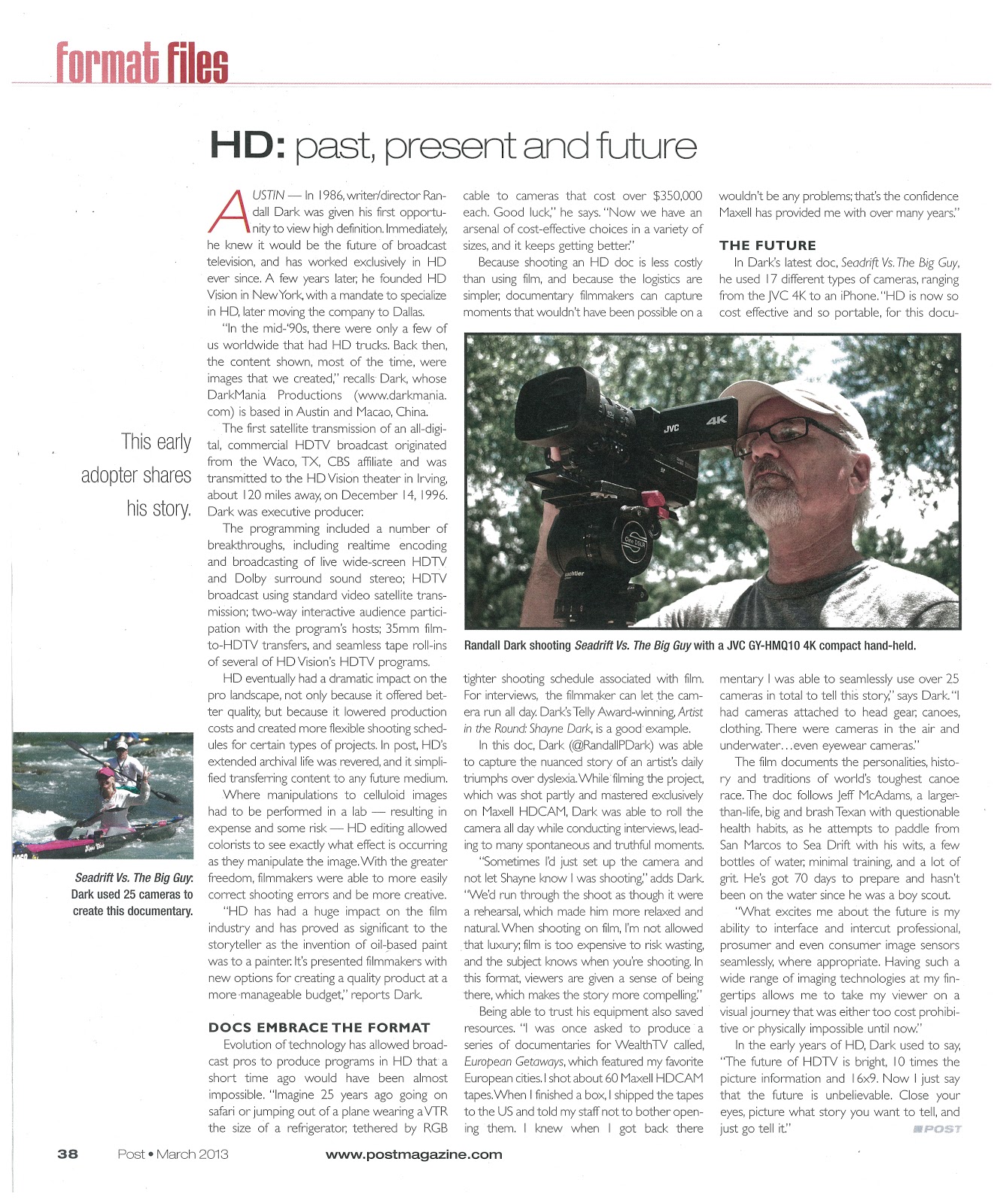
Randall P. Dark tells his story as an early adopter of HD to Post Magazine.

Tuesday, January 18, 2011

Eddie Willis and Randall Dark Team Up for a Performance Music Video

Eddie Willis recently completed his new CD titled "After the Music" and Randall Dark was looking for a debut project for his new edit suite. "I heard the rough track of "Glow" and I knew it would make the perfect performance music video," said Dark. “We decided to do some shooting during one of the final recording sessions and then at a number of other locations, one being a brand new stage in Austin under the control of Austin Ridge Productions. Producer, Kristen Cox and DP, Jim Flores rounded out the crew and I love the look we achieved.”

The music video will have a national broadcast and will be available on iTunes.


Artist: Eddie Willis
Album Title: After the Music
Song Title: Glow
Produced By: JJ Plasencio
Music Video Director: Randall P. Dark
Purchase on iTunes:
http://itunes.apple.com/us/album/after-the-music/id400519022

Austin Ridge Productions studio shoot.

Randall and Eddie at one of the locations for the video.

Monday, December 20, 2010

“Makarios: A Rising Tide”

FOR IMMEDIATE RELEASE

Randall Dark Productions and Austin Ridge Productions To Co-Produce the Story of Makarios

Randall Dark Productions, LP in association with Austin Ridge Productions, gathered a small crew and travelled through various remote villages in the Puerto Plata region of the Dominican Republic in late October in an effort to capture the story of a unique school called Makarios.

Directed and produced by HD Pioneers, Randall Dark and Kristen Cox, the documentary footage was captured in High Definition using two cameras. The crew spent 4 days shooting over 22 hours of footage. “We were shooting in tiny villages tucked into sugar cane fields where there was no electricity. I had to be very deliberate with our shoot schedule because we were limited to the amount of battery life we had. In order to make as small an impact as possible, we were minimalistic in our lighting and shooting approach,” said Kristen Cox, producer.

Makarios is a school that serves the poorest of the poor in the region. It provides opportunity for the next generation through education and dissolves bitter hatred by educating Dominican and Haitian children together. “These are the kinds of stories that need to be told; it’s why I became passionate about High Definition in the first place! When you look at these adorable little faces and learn that they only get to eat when they go to school, it’s going to break your heart. This technology opens a window to the world for viewers and will ignite a passion in them to help,” explained Randall Dark, director.

“Makarios: A Rising Tide” is currently in post production and is destined for completion early next year. Dark is in negotiations with broadcasters who are interested in airing the final program. La Cie has joined as a partial sponsor.

Tuesday, April 20, 2010

New program to air nationally on WealthTV


With awe-inspiring natural wonders and plenty of thrilling attractions, 3 Cities in 3D will feature the beauty, fun and excitement of Sevierville, Pigeon Forge and Gatlinburg, Tennessee in 3D. Produced, directed and shot by Randall Dark, the HD program will air nationally on WealthTV. Follow the production process on the official website and Facebook: 3 Cities In 3D

Wednesday, November 18, 2009

Teaser Trailer: Page Hill Battle (w.t)

The Dark/Marr Production feature film "Page Hill Battle" (w.t.) is currently in development. View the teaser trailer here: http://www.darkmarrproduction.com/

Monday, October 19, 2009

The Future of Independent Distribution

See for yourself where distribution is headed.

The Randall P. Dark channel beta test site:

Friday, October 16, 2009

New feature in development


Randall P. Dark has been tapped to produce the new feature "Page Hill Battle." Currently in development, the story is a political action thriller. Shane Marr is set to co-produce and direct.

Click here: Page Hill Battle (working title)

Monday, December 10, 2007

Dark to produce Smokejumpers

MEGALOMEDIA SIGNS RANDALL DARK TO PRODUCE SMOKEJUMPERS

(Austin TX- December 10, 2007) - The Austin based independent production company MEGALOMEDIA Inc., announced today the signing of acclaimed producer Randall Dark to produce on the series titled Smokejumpers. Dark is a High Definition (HD) pioneer and the president and founder of Randall Dark Productions.

"Randall Dark has such a presence and long history in the industry, we are excited for the opportunity to work together on this series," said Megalomedia's President and Smokejumpers' Executive Producer, Jonathan Nowzaradan. Dark will help produce an extraordinary new television series that takes you inside the lives of the elite men and women few who parachute in the most remote and dangerous areas of our country to battle wild land fires.

"The creative team at Megalomedia understands how to tell compelling stories," Dark said, "and as I have said for many years the best way to capture and see all of this is in true high definition.” Dark will also be joining producers Tom Mireles and Graham Davidson along with director Jeff Keels to bring the series to life.

About Megalomedia
Established in 2002, Megalomedia is a full-service television and film studio creating original, non-fiction television content from idea to the screen. Having recently wrapped production on the feature documentary, The World's Heaviest Woman, which airs on Channel 4 in the U.K. and later on TLC, they are also in production on other feature documentaries, including The Voice Gods of Hollywood and Aftershock: the Politics of a Natural Disaster along with the 10-part series, Smokejumpers.
www.megalomedia.com

About Randall Dark
Dark is considered to be one of the leading experts in High Definition. For more than 15 years he was the creative and marketing force behind HD Vision Inc. and HD Vision Studios. Recently he formed Randall Dark Productions to create television shows, independent films, commercials, documentaries, music videos, industrials or any other project in which HD is the medium of choice.
www.randalldark.net