Tuesday, December 23, 2014

HD and Beyond: A Conversation with Randall Dark


Recently Broadcast Engineering Extra's Bob Kovacs sat down with HDTV pioneer Randall Dark to discuss the state of television production, as well as what to expect from the upcoming SMPTE production of "Moving Images," which looks at the history of cinema and television.

BE Extra: What is it about motion pictures and television that has made them lasting forms of communication and art?

Dark: The traditional motion picture in a cinema is an immersive experience allowing an intense relationship between the story teller and the audience. Television also has this influence to a somewhat lesser degree, while having the advantage of allowing this communication to be immediate. Both art forms are powerful tools in the hands of creative people, and the evolving technology has allowed us to advance the art forms in many different ways that include sound and image quality, ultimately enhancing the viewing experience.

BE Extra: Tell us a little about the film that's tentatively titled Moving Images. What do you plan for it to contain? What is the intended audience?

Dark: Moving Images is the story of the people behind moving-picture technology. It focuses on the Society of Motion Picture and Television Engineers, which was founded in 1916, and will also look into the future. Filmmakers like Orson Welles, Alfred Hitchcock, Steven Spielberg and George Lucas are household names because of the way they managed to bring our imagination to life on screen. There are epic stories of triumph and tragedy amidst the engineers who painstakingly developed the technology and standards that ended up in the hands of creative filmmakers. This documentary will shine the spotlight on the unsung heroes who are the inventors and perfecters of what is arguably the most important communication tool in the history of the industrial age. There are many fascinating stories out there about how some amazing moments came to be, and we're going to pull back the curtain and show viewers how it all happens.

Other highlights include:

   - If HDTV has lived up to its potential
   - The "democratization" of video production
   - Dark's thoughts on Ultra HD/4K
   - Breaking into the business today in the midst of disruption

Read the entire interview on TV Technology.

Wednesday, December 10, 2014

SMPTE Taps Dark to Produce "Moving Images" Documentary


The Oscar and Emmy Award-winning Society of Motion Picture and Television Engineers (SMPTE) has named motion imaging technology and creative visionary Randall Dark as producer of the feature length documentary, "Moving Images." Howard Lukk, former vice president of production technology at The Walt Disney Studios will direct from an initial treatment written by Chris Kenneally.

"Moving Images" will explore excitement surrounding the development of motion imaging technology from the turn of the twentieth century through the present while inquiring what the future has in store. Featuring interviews with top filmmakers, historians, entrepreneurs and engineers, the documentary will investigate the influence art and science have on each other.

"SMPTE has played a vital role in the advancement of movies and television for nearly 100 years. I'm so honored that I get to help tell the story of the people who literally invented the technology that I've built my entire career on," said Dark.

The SMPTE Board of Governors authorized the initial funding for the project for a 90-minute theatrical feature, as well as an abbreviated television version. In order to continue with the production work required, SMPTE is now seeking supporters to underwrite the project through an Indiegogo campaign. Supporters will become part of the SMPTE legacy of setting the standard for motion imaging.

For more information on the "Moving Images" documentary, visit the project's Indiegogo page.


Friday, June 13, 2014

University of Ottawa Feature Story on Randall P. Dark

High Definition Visionary

Years before TV went digital, theatre grad Randall Dark was well ahead of the curve when it came to exploiting the revolutionary potential of HD.

The University of Ottawa's online magazine, Tabaret, is a digital publication highlighting the stories that have shaped and continue to shape the university's history. The June 2014 issue features an in-depth story on alum Randall P. Dark.

"Because high definition was so real and so vivid, I believed that if you watched a documentary about starving children, it would touch your heart in a way that you would have to react." ~ Randall P. Dark

Randall Dark using a 3D camera to film penguins for the film 3 Cities in 3D, which featured images from Gatlinburg, Sevierville and Pigeon Forge, all in Tennessee.
Randall P. Dark (BA ΚΌ79, Honours), one of the pioneers of high definition television, says he embraced the technology because he believed sharper images had the power to change the world. But it wasn't easy convincing film industry bigwigs of the merits of HD.

"I was laughed at many, many times," says Dark. "After one demonstration of HD to some of the top cinematographers, directors and producers in New York City, I was viciously attacked. They were saying it looked like video, it was horrible, it was never going to happen. I remember one of my staff asking me, 'Randall, how do you feel? They tore you apart.' But I was elated. I said, 'Did you see how passionately vicious they were, how much they hated it? If it touched them that much, we're on to something.'"

Today, Dark is a producer, director, cinematographer, writer and media consultant who has shot some of the most famous personalities in high definition, including Julie Andrews, Willie Nelson, Harry Connick Jr., Lyle Lovett, Sting, Bill Clinton, Leonard Nimoy and Stephen Hawking. He is considered by the television industry to be a visionary guru who has played a key role in advancing the HD medium.

Dark compares the moment he first saw HD in Toronto in 1986 to someone seeing a Model T Ford during the days of horses and carriages.

"My brain fired and I thought this was going to be the future of so many things. I wanted to help bring it to the world and I was blessed enough to be involved in so much of the roll-out," says Dark.

"Because high definition was so real and so vivid — the colors were perfect, you could see the tiniest detail — I believed that if you had a 65-inch TV in your home and you watched a documentary about starving children, it would touch your heart in a way that you would have to react," says Dark. "I believed it was a technology that would have an impact on people and change their hearts. I honestly believed it would change humanity."

Read the full story by Mike Foster online here

Tuesday, April 15, 2014

XiN Magazine Profile


XiN Magazine painted a vivid word portrait of Randall Paris Dark in China Stories. Read the article in Chinese and English here.

Wednesday, February 26, 2014

Documentary Team Used Everything But the Kitchen Sink

REVIEW: "Seadrift vs. The Big Guy"

Director/Cinematographer Randall P. Dark


Randall P. Dark filming "Seadrift vs. The Big Guy"
"Seadrift vs. The Big Guy" presents the viewer not only with an involving look at a group of very determined sports enthusiasts taking on a daunting physical challenge, but also a technological tour de force of digital filmmaking. The combination of video formats from cell phone to eyewear to 4K is impressively successful, demonstrating that source material can come from any perspective both subjectively from the participants and objectively from observers.

This allows the point of view of those directly experiencing the event to become as important as the cinematography of the filmmaker.

Participants in the Texas Water Safari, the subject
of the documentary

The result is that only the editorial selection of the shots the documentarian chooses to include sets the parameters of the ultimate communication, rather than the limitations of his or her production capabilities. In my opinion, by demonstrating the unlimited potential of multiple video formats, this "Seadrift vs. The Big Guy" is a landmark in the future of potential filmmaking.

Jay Ankeney

Thursday, August 22, 2013

Behind the Camera: Randall Dark

Randall P. Dark was interviewed for Randi Altman's postPerspective about choosing the right tools for the right job. Read the article in its entirety at postPerspective.


Thursday, March 28, 2013

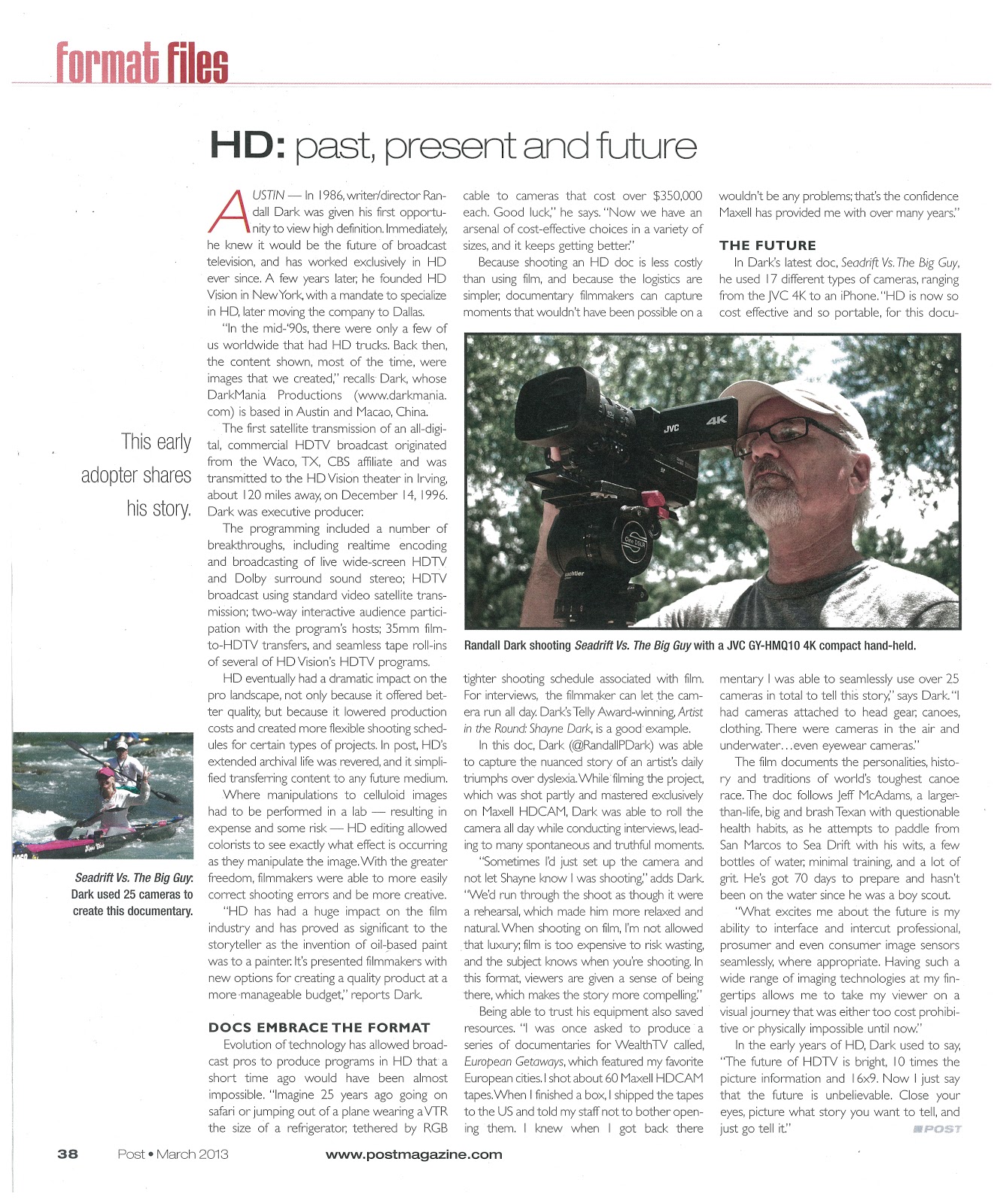
HD: Past, Present, Future

Randall P. Dark tells his story as an early adopter of HD to Post Magazine.